• Blutige Nase geholt: Augstein vs. Hanson

    Jakob Augstein verkörpert den bundesdeutschen Gesinnungsjournalismus, wie kaum ein anderer. In einem kürzlich erschienen Artikel verkündet er: „In Amerika regiert der politische Irrsinn. Die USA sind ein politisch und sozial zerrissener failed state.“

    Der Artikel ist auch in englischer Sprache erschienen. In dieser Version hat er die Aufmerksamkeit des namhaften Historikers Victor Davis Hanson gefunden. Die Antwort des kalifornischen Gelehrten trägt den schönen Titel „An Anatomy of European Nonsense. The Silliest Column I Have Ever Read“.

    Augstein:

    Der soziale Zerfall dieses reichen Landes ist atemberaubend. Der Wirtschaftsnobelpreisträger Joseph Stiglitz hat ihn jüngst beschrieben: Das reichste Prozent der Amerikaner reklamiert gut ein Viertel des Gesamteinkommens für sich – vor 25 Jahren waren es zwölf Prozent. Es besitzt 40 Prozent des Gesamtvermögens – vor 25 Jahren waren es 33 Prozent. Stiglitz sagt, dass sich in vielen Ländern der sogenannten Dritten Welt die Einkommensunterschiede zwischen Arm und Reich reduziert hätten. In den USA sind sie gewachsen.

    Hanson:

    Most of the extraordinary wealth of America’s richest — a Bill Gates, Jr. or Warren Buffett — is based on the advent of American-style globalization that opened up new markets for products and financial services, or brought in billions in foreign investment. In response, never has the top 1% paid a greater percentage of the aggregate income tax (the top 1% pays almost 40% of all income tax revenues collected; the top 5% pays almost 60%; the bottom 50% of households pays essentially nothing in income tax). But the barometer of national health should be not be found necessarily in income disparity, but rather in the per capita income of Americans. As American companies and financial institutions made unprecedented profits from global commerce and investment, so too did the standard of living of all Americans rise between 1980s and 2008. […] By measures of access of the poor and middle class to electronic goods, cars, or square footage of living space, the U.S. far exceeds the European mean. Such opportunity explains why some 10-15 million Mexican nationals, without legality, education or English, have flocked to the United States.

    Genau! Sonst wäre nicht zu erklären, weshalb so viele Menschen aus anderen Staaten in die USA möchten. Diesen simplen Umstand hat Augstein übersehen. Hören wir ihn weiter:

    Amerika hat sich verändert. Es hat sich vom Westen entfernt.

    Hanson:

    Even this simple assertion is wrong. America is drifting as never before toward Europe—the ostensible model for an Obama administration that has borrowed nearly $5 trillion in three years, federalized health care, assumed control of private companies, blocked new plant openings, is eager to increase taxation, and seeks to subordinate U.S. foreign policy to the United Nations, as we see in the case of Libya, where the Obama administration went to the Arab League, the United Nations, and its European allies, but not to the U.S. Congress for authorization.

    Augstein:

    In dem Maße, in dem sich Amerika uns entfremdet, werden wir lernen (müssen), als Europäer zu denken. Der Westen, das sind wir.

    Hanson:

    Mr. Augstein should be thinking not of ridding America from the West, but whether the West will still include a united Europe, which is proving as undemocratic as it is unable to continue the basic premises of the welfare state. […] The desire for “distance” unfortunately is not just confined to European elites like Mr. Augstein himself, but is voiced more often by a far greater numbers of Americans, who cannot quite fathom the premises of postmodern Europe, much less why in tough financial times we should be subsidizing the security of a system that won’t pay for what it thinks it requires for its own protection […].  If the French and British military record in Libya or the German-Greek negotiations are a blueprint for a new definition of European singularity, then God help our trans-Atlantic cousins, since America will soon no longer be willing or able to.

    Amen.
  • |

    Zbigniew Herbert, Rozmyślania Pana Cogito o odkupieniu

    Zbigniew Herberts „Herrn Cogitos Gedanken über die Erlösung“ gefallen mir sehr.

    Nie powinien przysyłać syna

    zbyt wielu widziało
    przebite dłonie syna
    jego zwykłą skórę

    zapisane to było
    aby nas pojednać
    najgorszym pojednaniem

    zbyt wiele nozdrzy
    chłonęło z lubością
    zapach jego strachu

    nie wolno schodzić
    nisko
    bratać się krwią

    nie powinien przysyłać syna
    lepiej było królować
    w barokowym pałacu z marmurowych chmur

    na tronie przerażenia
    z berłem śmierci

    „Er hätte den Sohn nicht zu uns senden sollen/zu Viele sahen/die durchschlagenen Hände des Sohnes/seine gewöhnliche Haut/ […] zu viele Nüstern/sogen mit Vergnügen ein/den Geruch seiner Angst/ […] er hätte den Sohn nicht zu uns senden sollen/besser wäre es wie ein König zu herrschen/in einem üppigen Palast aus marmornen Wolken/auf dem Thron des Entsetzens/mit dem Szepter des Todes“

    Ein drohender Gott ist vielen leichter erträglich. Mit dem zu uns Gekommenen sind wir – ganz offenbar – nicht zufrieden.

    Stefan George beschreibt, welche Sehnsüchte uns dabei treiben mögen:

    Der Widerchrist

    „Dort kommt er vom berge · dort steht er im hain!
    Wir sahen es selber · er wandelt in wein
    Das wasser und spricht mit den toten.“

    O könntet ihr hören mein lachen bei nacht:
    Nun schlug meine stunde · nun füllt sich das garn ·
    Nun strömen die fische zum hamen.

    Die weisen die toren – toll wälzt sich das volk ·
    Entwurzelt die bäume · zerklittert das korn ·
    Macht bahn für den zug des Erstandnen.

    Kein werk ist des himmels das ich euch nicht tu.
    Ein haarbreit nur fehlt · und ihr merkt nicht den trug
    Mit euren geschlagenen sinnen.

    Ich schaff euch für alles was selten und schwer
    Das Leichte · ein ding das wie gold ist aus lehm ·
    Wie duft ist und saft ist und würze –

    Und was sich der grosse profet nicht getraut:
    Die kunst ohne roden und säen und baun
    Zu saugen gespeicherte kräfte.

    Der Fürst des Geziefers verbreitet sein reich ·
    Kein schatz der ihm mangelt · kein glück das ihm weicht..
    Zu grund mit dem rest der empörer!

    Ihr jauchzet · entzückt von dem teuflischen schein..
    Verprasset was blieb von dem früheren seim
    Und fühlt erst die not vor dem ende.

    Dann hängt ihr die zunge am trocknenden trog ·
    Irrt ratlos wie vieh durch den brennenden hof..
    Und schrecklich erschallt die posaune.

    Für George sind es die Sehnsüchte der Masse.

    Welches Gedicht ist das stärkere? Von der Form kann gegenwärtig nicht die Rede sein, denn das Herbertsche Gedicht besitzt keine. Über den Inhalt läßt sich sagen: Herbert bleibt ganz im Privaten. George bewegt sich (wenigstens auch) im Politischen: Seine Verse durchzieht die Kritik an der Masse. Von Vielheit ist auch bei Herbert die Rede: „zbyt wielu“/“zbyt wiele“. Aber das sind eben „zu Viele“/“zu viele“, das kann jeder von uns sein. „Menge“ oder „Masse“ („toll wälzt sich das volk“) sind immer die Anderen…

  • |

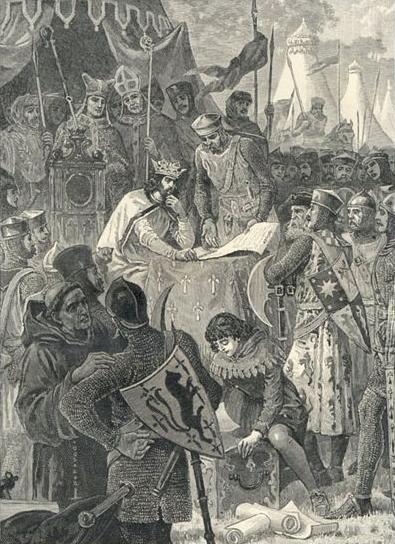
    Rudyard Kipling: Gestern vor knapp 800 Jahren

    Rudyard Kiplings „The Reeds of Runnymede“ (Magna Charta, June 15, 1215) — mit einigen Hervorhebungen und Kommentaren.

    At Runnymede, at Runnymede
    What say the reeds at Runnymede?
    The lissom reeds that give and take,
    That bend so far, but never break.
    They keep the sleepy Thames awake
    With tales of John at Runnymede.

    At Runnymede, at Runnymede,
    Oh, hear the reeds at Runnymede: —
    „You mustn’t sell, delay, deny,
    A freeman’s right or liberty.
    It wakes the stubborn Englishry,
    We saw ‚em roused at Runnymede!

    Rechte sind „negativ“; sie verbieten dem Staat und dem Mitbürger, dies und jenes mit einem Menschen zu tun. Und sie müssen verteidigt werden.

    „When through our ranks the Barons came,
    With little thought of praise or blame,
    But resolute to play the game,
    They lumbered up to Runnymede;
    And there they launched in solid line
    The first attack on Right Divine —
    The curt, uncompromising ‚Sign!‘
    That settled John at Runnymede.

    „At Runnymede, at Runnymede,
    Your rights were won at Runnymede!
    No freeman shall be fined or bound,
    Or dispossessed of freehold ground,
    Except by lawful judgment found
    And passed upon him by his peers.
    Forget not, after all these years,
    The Charter Signed at Runnymede.“

    Rechte fallen nicht vom Himmel; sie müssen erkämpft werden.

    And still when Mob or Monarch lays
    Too rude a hand on English ways,
    The whisper wakes, the shudder plays,
    Across the reeds at Runnymede.
    And Thames, that knows the moods of kings,
    And crowds and priests and suchlike things,
    Rolls deep and dreadful as he brings
    Their warning down from Runnymede!

    Die Herrschaft des Rechts (Rule of Law) darf nicht mit der Herrschaft der Mehrheit des Volkes verwechselt werden. Die Frage, wer herrschen soll, ist irreführend. Es geht darum, was herrschen soll: Ein Recht, das jeden einzelnen Bürger vor Staat und Mitbürgern schützt.

  • |

    Der Bildungsauftrag öffentlich-rechtlicher Medien in historischer Perspektive

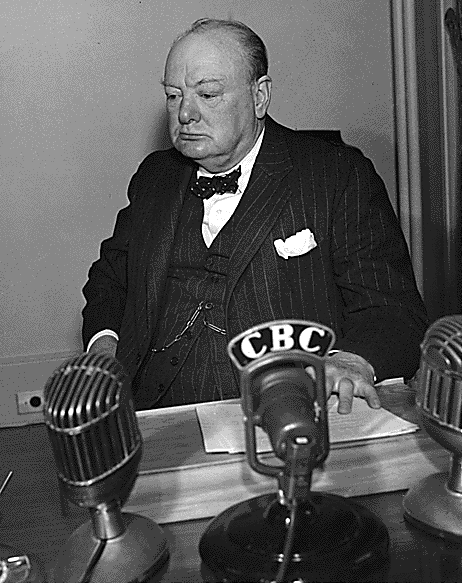
    Als Winston Churchill ’störte‘. Milton Friedman:

    From 1933 to the outbreak of World War II, Churchill was not permitted to talk over the British radio, which was, of course, a government monopoly administered by the British Broadcasting Corporation. Here was a leading citizen of his country, a Member of Parliament, a former cabinet minister, a man who was desperately trying by every device possible to persuade his countrymen to take steps to ward off the menace of Hitler’s Germany. He was not permitted to talk over the radio to the British people because the BBC was a government monopoly and his position was too „controversial“.

    (Capitalism and Freedom, Chicago 2002, S. 19.)

  • |

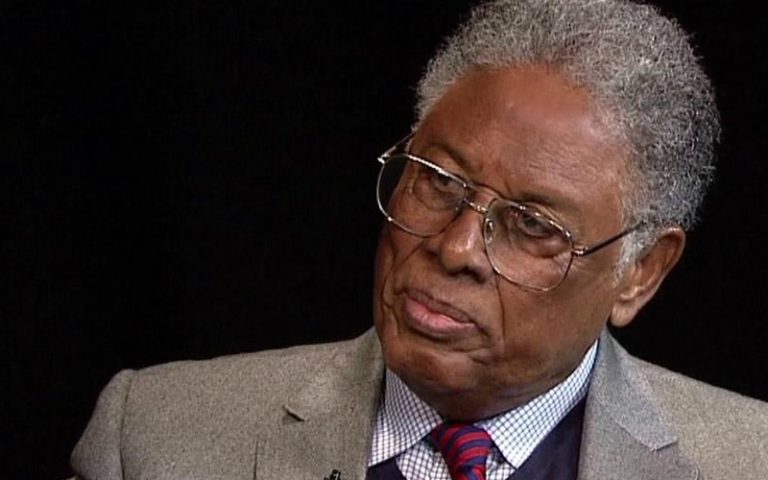
    Thomes Sowell: Lob strenger Lehrer

    Das Bemerkenswerte ist doch, daß wir uns kaum an die „netten“ Lehrer erinnern, sondern an die, von denen wir etwas gelernt haben… Kein Video im eigentlichen Sinne, sondern ein gelesener Text aus der Feder Thomas Sowells – hier.

  • |

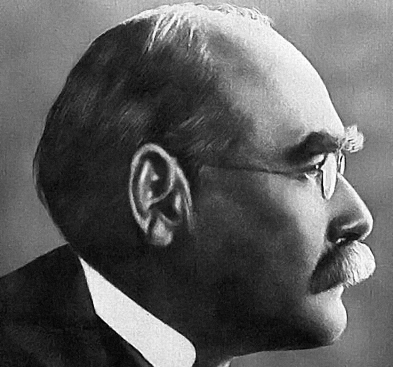
    Mit Rudyard Kipling zum neuen Jahr

    Dane-Geld

    A.D. 980-1016

    It is always a temptation to an armed and agile nation
    To call upon a neighbour and to say: —
    „We invaded you last night – we are quite prepared to fight,
    Unless you pay us cash to go away.“

    And that is called asking for Dane-geld,
    And the people who ask it explain
    That you’ve only to pay ‚em the Dane-geld
    And then you’ll get rid of the Dane!

    It is always a temptation for a rich and lazy nation,
    To puff and look important and to say: —
    „Though we know we should defeat you, we have not the time to meet you.
    We will therefore pay you cash to go away.“

    And that is called paying the Dane-Geld;
    But we’ve proved it again and again,
    That if once you have paid him the Dane-geld
    You never get rid of the Dane.

    It is wrong to put temptation in the path of any nation,
    For fear they should succumb and go astray;
    So when you are requested to pay up or be molested,
    You will find it better policy to say: —

    „We never pay any-one Dane-Geld,
    No matter how trifling the cost;
    For the end of that game is oppression and shame,
    And the nation that pays it is lost!